10 Real-Life Things That Are About 6 cm Big
how big is 6 cm? 6 cm is equal to 60 millimeters or approximately 2.36 inches. On an inch ruler, it sits just under 2⅜ inches and is slightly shorter than 2½ inches. A simple way to picture this size is through familiar objects and everyday comparisons.
If you are trying to picture how big is 6 cm, the number alone may not tell you much. Six centimeters equals 60 millimeters or about 2.36 inches, so it is a short but noticeable measurement that falls between 2 and 2½ inches.
You might see 6 cm listed in product descriptions, jewelry sizes, cabinet hardware, camera accessories, craft supplies, or other small items. Without a ruler nearby, it can be hard to tell whether something measuring 6 cm will look tiny, small, or larger than expected.
The easiest way to picture this size is to compare it with familiar objects and known measurements. In this guide, you’ll see what 6 cm looks like, how it compares with nearby measurements, ways to estimate it without a ruler, and real examples that give you a clearer sense of its actual size.
For another useful comparison, see exactly
how long 2 inches is.
How Big Is 6 cm?
A measurement of 6 cm is equal to 60 mm or 2.36 inches. On a metric ruler, it reaches the number 6. On an inch ruler, it falls between 2¼ inches and 2½ inches, sitting very close to 2⅜ inches.
Six centimeters is larger than 2 inches but does not quite reach 2½ inches. That makes it a useful size to know when comparing small products, accessories, tools, and other everyday items.
You can think of it this way:
- 6 cm = 60 mm
- 6 cm = 2.36 inches
- 6 cm is just under 2½ inches
- 6 cm is slightly longer than 2 inches
A related internal link can be placed naturally here to your How Big Is 5 cm? article so readers can compare the two measurements.
📏 6 cm at a Glance
| Measurement | Equivalent |
| Centimeters | 6 cm |
| Millimeters | 60 mm |
| Inches | 2.36 in |
| Approximate fraction | 2⅜ in |
| Meters | 0.06 m |
| Feet | 0.197 ft |
6 cm Conversion Table
| Unit | Value |
| Millimeters | 60 mm |
| Inches | 2.36 in |
| Meters | 0.06 m |
| Feet | 0.197 ft |
| 2 inches | 5.08 cm |
| 2½ inches | 6.35 cm |
One important detail is that 6 cm is not exactly 2½ inches. A measurement of 2½ inches equals 6.35 cm, making it 3.5 mm longer than 6 cm.
Why You See 6 cm More Often Than You Realize
Six centimeters appears in many products because it is a practical size for compact parts and accessories. It is large enough to handle comfortably but small enough to fit into tight spaces, packaging, pockets, drawers, and small storage containers.
You may come across this measurement when looking at camera accessories, furniture hardware, baking tools, craft materials, laboratory equipment, or replacement parts. Many of these products use millimeters rather than centimeters, so the same measurement may appear as 60 mm.
Product dimensions are especially important when shopping online. Seeing “6 cm” in a listing may not immediately create a clear picture, but knowing that it is just under 2½ inches can make the size much easier to judge.
It is also useful when comparing objects that need to fit together. A small difference of one centimeter can matter when choosing a replacement knob, filter, lid, cutter, or other precisely sized item.
What Does 6 cm Look Like?
The easiest exact way to picture 6 cm is as a straight line running from 0 to 6 on a metric ruler.
On an inch ruler, the same distance measures 2.36 inches. It is longer than 2¼ inches and stops just before the 2⅜-inch mark.
Another useful way to picture the size is through familiar objects. The National Cancer Institute uses an egg as a visual comparison for 6 cm in its educational illustration of tumor sizes. In the same scale, 5 cm is represented by a lime and 7 cm by a peach. This is a visual reference rather than a claim that every egg measures exactly 6 cm.
Six centimeters can also look different depending on the type of measurement. A 6 cm straight line, a 6 cm-wide object, and a circle with a 6 cm diameter all use the same measurement but create different visual impressions.
Visualizing 6 cm Without Picking Up a Ruler
Imagine a small section of a notebook page. A 6 cm line takes up only a short part of the page, but it is long enough to be clearly visible and easy to compare with small everyday objects.
It also fits comfortably across part of an adult palm without reaching from one side of the hand to the other. Since hand sizes differ, this is only a general way to visualize the measurement.
Another rough reference is the combined width of several fingers. Depending on the person, four fingers placed together may come close to 6 cm, but finger widths vary too much for this to be treated as an exact measurement.
The best visual references are objects with a published 60 mm dimension, because 60 mm is exactly the same as 6 cm.
How to Measure 6 cm Without a Ruler
You can estimate 6 cm without a ruler in several ways, although some are more accurate than others.
Using Your Fingers
For many adults, the combined width of several fingers can come close to 6 cm. This method is useful when you only need a rough estimate.
However, finger widths vary between people. It should not be used when accuracy matters for cutting, fitting parts, or other precise work.
Using Your Hand
A short 6 cm line can fit comfortably across part of your palm. Looking at your hand can give you a general idea of the scale, especially when you simply need to judge whether something is around 2 or 3 inches.
Because hand proportions are different for everyone, this method works best as a visual estimate rather than an exact measurement.
Using Common Objects
A more reliable approach is to use an item with a known measurement. For example, a product labeled 60 mm gives you an exact 6 cm reference for the stated dimension.
Camera accessories, cabinet hardware, laboratory dishes, circular cutters, and similar products often use millimeter specifications.
When comparing objects, always check whether the stated 60 mm measurement refers to the length, width, or diameter.
10 Things That Are Exactly or About 6 cm Big
The examples below improve on simple “close enough” comparisons by separating verified 60 mm references from general visual comparisons. This avoids treating every common object as if it has one universal size.
1. A 60 mm Cabinet Knob
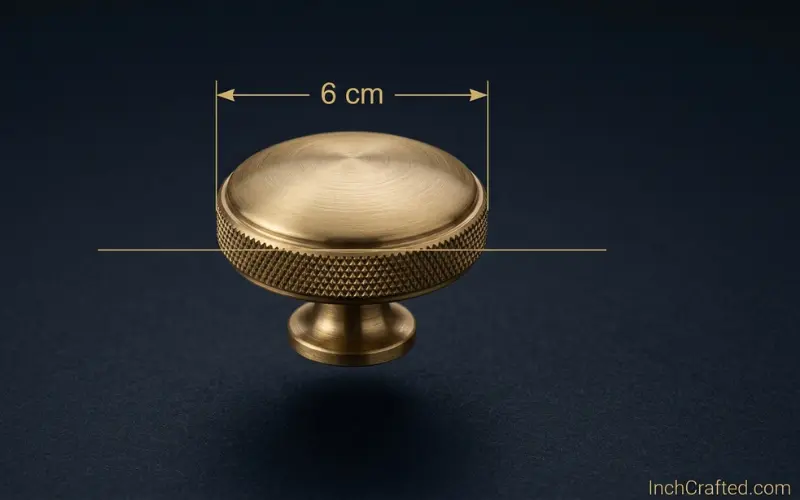
Cabinet knobs are available in many sizes, and some models are specifically manufactured with a 60 mm diameter. When a manufacturer lists the diameter as 60 mm, the knob measures exactly 6 cm across.
This gives you a useful example of how 6 cm looks in a circular shape. A knob of this size is noticeable on a cabinet or drawer without looking oversized.
The main advantage of using a specification-based example is accuracy. Unlike a generic household object, the exact 60 mm dimension can be checked before using it as a comparison.
2. A 60 mm Camera Lens Cap

Camera lens caps and related accessories are often identified by their millimeter size. A lens cap designed for a 60 mm diameter provides a direct 6 cm reference across.
This makes photography equipment useful for understanding small measurements. The circular face of the accessory gives you a clear view of the full 6 cm span.
Not every lens cap measures 60 mm, so the specific model or specification matters. A 58 mm or 62 mm cap is close, but it is not the same measurement.
3. A 60 mm Round Cookie Cutter

Round cookie cutters are sold in standardized sizes, including 60 mm versions. A cutter marked 60 mm has a 6 cm diameter across its circular opening.
This makes it easier to picture how large a 6 cm circle looks on a baking tray or kitchen counter. The opening is wide enough for a small biscuit or pastry while remaining compact.
Because the size is stated by the product specification, this is more reliable than guessing from the size of an ordinary cookie.
4. A 60 mm Hole Saw

Hole saws are commonly sold according to the diameter of the hole they cut. A 60 mm hole saw creates an opening approximately 6 cm across according to its stated size.
This is a useful example because it shows 6 cm in a practical DIY setting. A circular opening of that size is large enough to notice clearly but still relatively small compared with larger plumbing or construction openings.
As with any tool, the exact cutting size should be checked in the manufacturer’s specifications before using a particular model as a reference.
5. A 60 mm Petri Dish

Petri dishes are available in standardized diameters. A 60 mm Petri dish measures exactly 6 cm across from one side to the other through its center.
Its simple shape makes it easy to visualize the measurement. When viewed from above, you can see the entire 6 cm diameter at once.
This is a particularly useful reference because laboratory products often use precise metric dimensions rather than rough estimates.
6. A 60 mm Circular Craft Template

Craft templates, labels, punches, and cutouts are often sold in millimeter sizes. A circle labeled 60 mm has an exact diameter of 6 cm.
This gives you a practical reference for paper crafts, stickers, decorations, and other creative projects. A 6 cm circle is compact but still large enough to hold a small design or several words of text.
It also shows why the type of measurement matters. The diameter is 6 cm, while the distance around the outside of the circle is much longer.
7. A 60 mm Camera Filter
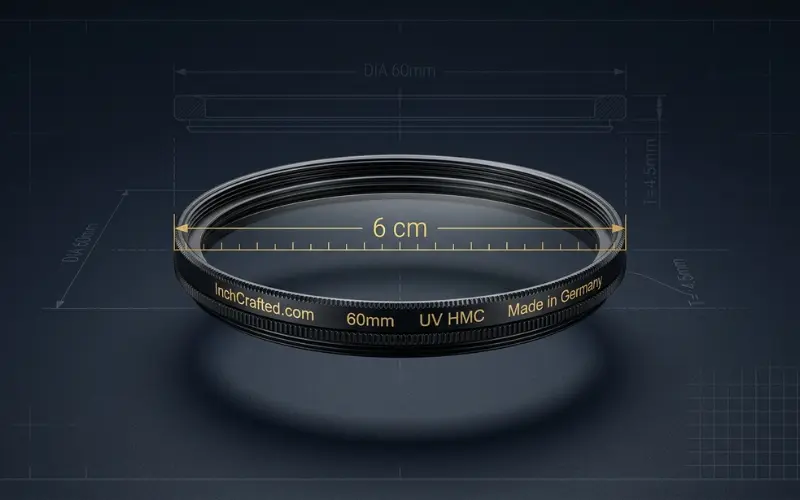
Camera filters are commonly identified by their thread diameter. A filter specifically made in a 60 mm size gives you another accurate reference for a 6 cm circular measurement.
The filter’s width can help when trying to visualize product dimensions. Holding a circular accessory of this size gives you a better sense of the measurement than simply reading 2.36 inches.
Camera equipment comes in many standard sizes, so only a filter with a stated 60 mm specification should be used as an exact comparison.
8. An Egg as a Visual Size Reference

An egg is not a precision measuring tool because eggs vary in size and shape. However, the National Cancer Institute uses an egg as its visual comparison for 6 cm in an educational size chart.
That makes an egg one of the most recognizable ways to form a quick mental image of this measurement.
Think of this as a visual comparison rather than an exact object dimension. It is useful when you want to understand the overall scale of 6 cm without looking at a ruler.
9. Just Under 2⅜ Inches on a Ruler

If you use inches more often than centimeters, this may be the most useful comparison of all.
Six centimeters equals 2.3622 inches. The common fraction 2⅜ inches equals approximately 6.03 cm, so 6 cm sits just slightly before that mark.
This gives you a precise location on an inch ruler and avoids the common mistake of treating 6 cm as exactly 2½ inches.
10. A 60 mm Line on Paper

A simple line measured from 0 to 6 on a metric ruler is the most direct physical representation of 6 cm.
Drawing the line on paper allows you to place objects beside it and compare their actual size. This can be useful when shopping online or checking whether a product will fit into a particular space.
Once you have seen a 6 cm line next to familiar objects, the measurement becomes much easier to recognize without measuring every time.
If you want to compare an even smaller everyday measurement, our guide on how big is 4 cm shows what 4 centimeters looks like in real life.Where You’ll Notice 6 cm in Everyday Life
You may encounter 6 cm when checking product dimensions online. Small accessories often list measurements in centimeters or millimeters, especially products manufactured for international markets.
Furniture hardware is one common example. Knobs, handles, pads, and other replacement parts can be listed in millimeters, making a 60 mm specification useful to recognize.
Photography equipment is another area where millimeter measurements are common. Filters, lens accessories, and related parts may use exact dimensions because compatibility depends on size.
Crafting and DIY projects also regularly use metric measurements. Circular templates, cutters, hole saws, labels, and similar tools may be available in 60 mm sizes.
Laboratory and educational equipment can use standardized dimensions as well. A 60 mm dish, for example, provides a clear metric reference.
Comparing 6 cm With Other Common Measurements
5 cm vs 6 cm
The difference between 5 cm and 6 cm is only one centimeter, but it is noticeable when comparing small objects side by side.
5 cm = 1.97 inches, while 6 cm = 2.36 inches.
That extra centimeter can matter when choosing accessories, replacement parts, or products that need to fit within a limited space.
A natural internal link to How Big Is 5 cm? fits well in this section.
6 cm vs 7 cm
Seven centimeters is one centimeter longer than 6 cm.
6 cm = 2.36 inches
7 cm = 2.76 inches
The difference may seem small on paper, but it becomes easier to see when comparing two objects next to each other. A 7 cm item extends farther while still remaining within the same general small-size range.
You can link naturally here to How Big Is 7 cm?.
For a larger comparison, you can also see how big is 10 cm.6 cm vs 10 cm
Ten centimeters is considerably larger than 6 cm.
10 cm = 3.94 inches, while 6 cm is only 2.36 inches.
The difference is 4 cm, which means a 10 cm object is more than one and a half times as long as a 6 cm object.
Comparing these two sizes is useful when a product description lists dimensions in centimeters and you are trying to decide whether an item is compact or medium-sized.
A difference of one centimeter can be easier to picture when you compare it with our detailed guide on how big is 5 cm.6 cm vs 2 Inches and 2½ Inches
This is one comparison both competitor approaches could make clearer.
| Measurement | Equivalent |
| 2 inches | 5.08 cm |
| 2¼ inches | 5.72 cm |
| 6 cm | 2.36 in |
| 2⅜ inches | 6.03 cm |
| 2½ inches | 6.35 cm |
This shows exactly where 6 cm sits on an inch ruler: a little before 2⅜ inches and clearly before 2½ inches.
How Big Is a 6 cm Tumor?
A 6 cm tumor measures about 2.36 inches at the dimension being reported.
For a visual comparison, the National Cancer Institute’s educational tumor-size illustration uses an egg to represent 6 cm. The same illustration uses a lime for 5 cm, an egg for 6 cm, and a peach for 7 cm.
This comparison is only meant to help visualize size. A tumor does not necessarily have the shape of an egg.
A medical report may describe a mass with more than one dimension, such as 6 × 4 × 3 cm. In that example, 6 cm is the largest listed dimension and does not mean the mass is 6 cm in every direction.
The medical significance of a 6 cm tumor cannot be determined from size alone. The meaning depends on the type of tumor, its location, pathology, grade, and other clinical findings. Tumor-size illustrations help people picture the measurement, but the measurement itself does not provide a complete diagnosis or staging result.
Common Mistakes When Estimating 6 cm
Confusing 6 cm With 6 Inches
These are very different measurements.
6 cm = 2.36 inches
6 inches = 15.24 cm
Six inches is more than twice as long as 6 cm.
Assuming 6 cm Is Exactly 2½ Inches
This is close, but not exact.
6 cm = 2.36 inches
2½ inches = 6.35 cm
The difference is 3.5 mm.
Treating Every Object in the Same Category as 6 cm
Not every cabinet knob, lens cap, egg, cookie cutter, or Petri dish has the same size.
A product should only be used as an exact 6 cm comparison when its specification states 60 mm or 6 cm.
Mixing Up Diameter and Length
A circle with a 6 cm diameter measures 6 cm from one side to the other through the center.
That does not mean its circumference is 6 cm. Always check which dimension is being described.
Measuring From the Edge of a Ruler Instead of the Zero Mark
Some rulers have a small gap before the printed zero line. Starting from the physical edge instead of the zero mark can lead to inaccurate measurements.
For the best result, place the beginning of the object at 0 and read the measurement at the opposite end.
FAQs
How big is 6 cm in inches?
6 cm equals approximately 2.36 inches.
Is 6 cm equal to 2 inches?
No. 2 inches equals 5.08 cm, while 6 cm is about 2.36 inches.
Is 6 cm close to 2½ inches?
Yes. Six centimeters is only 0.35 cm shorter than 2½ inches.
What does 6 cm look like?
It is about 2.36 inches, or just under 2⅜ inches on a ruler. For a general visual reference, the National Cancer Institute uses an egg to represent 6 cm in its tumor-size illustration.
How many millimeters are in 6 cm?
There are 60 millimeters in 6 centimeters.
Can I estimate 6 cm without a ruler?
Yes. You can use an object with a verified 60 mm dimension, compare it with approximately 2.36 inches, or use your hand and fingers for a rough estimate.
Is 6 cm considered small?
For most everyday products, yes. Six centimeters is a compact measurement commonly found in small accessories, hardware, camera equipment, and craft supplies.
What are some things that are exactly 6 cm?
Products with a stated 60 mm measurement can provide exact examples. These may include certain cabinet knobs, camera accessories, Petri dishes, craft circles, cookie cutters, and other standardized products.
How big is a 6 cm tumor?
A 6 cm tumor measures approximately 2.36 inches at the reported dimension. The National Cancer Institute uses an egg as a visual comparison for 6 cm, but the medical meaning of the measurement depends on the specific tumor and clinical context.
Is a 6 cm tumor automatically cancer?
No. The size of a mass or tumor alone does not determine whether it is benign or malignant. The diagnosis depends on the specific medical evaluation.
Conclusion
Six centimeters is equal to 60 millimeters or approximately 2.36 inches. It is a compact measurement that sits between 2¼ and 2½ inches and is just slightly shorter than 2⅜ inches.
The easiest way to picture 6 cm is to compare it with a ruler, a verified 60 mm product, or a familiar visual reference. For everyday estimating, knowing that 6 cm is a little longer than 2 inches and just short of 2½ inches gives you a quick sense of scale.
Unlike pages that rely only on loosely sized household objects or repeat multiple versions of the same circular 60 mm product, this guide separates exact references from rough visual comparisons and explains where 6 cm actually sits against nearby measurements. The two main competitors take those different approaches, which leaves room for a page that combines clarity, precision, and broader search-intent coverage.