9 Common Things That Are About 7 cm Long
7 cm is equal to 70 millimeters or approximately 2.76 inches. It is just above 2¾ inches and slightly shorter than 3 inches, making it easy to visualize as a small but noticeable measurement.
If you are wondering how big is 7 cm, the easiest answer is to compare it with a measurement you already know. Seven centimeters equals 70 millimeters or approximately 2.76 inches. It is slightly shorter than 3 inches and a little longer than 2¾ inches.
You may see 7 cm listed on a product description, medical report, pregnancy information, craft project, or measuring guide and want to know what that size actually looks like. A number alone can be difficult to picture, especially when you do not have a ruler nearby.
This guide shows what 7 cm looks like in real life, where it sits on an inch ruler, how to estimate it without measuring tools, and how it compares with nearby measurements. It also separates exact measurement references from approximate visual comparisons so you know which examples can actually be relied on.
If you are comparing nearby measurements, our guide on how big is 6 cm makes it easy to see how much difference one additional centimeter can make.7 cm Conversion Table
| Measurement | Equivalent |
|---|---|
| 7 Centimeters | 7 cm |
| Millimeters | 70 mm |
| Inches | 2.76 inches |
| Nearest Fraction | About 2¾ inches |
| 3 Inches | 7.62 cm |
| Meters | 0.07 m |
| Feet | 0.23 ft |
How Big Is 7 cm?
7 cm is equal to 70 mm or approximately 2.76 inches.
On a metric ruler, it extends from the 0 mark to the 7 cm mark. On an inch ruler, it falls just above 2¾ inches and remains slightly short of 3 inches.
Here is the simplest way to picture it:
- 7 cm = 70 mm
- 7 cm = 2.76 inches
- 7 cm is slightly longer than 2¾ inches
- 7 cm is 0.24 inches shorter than 3 inches
- 7 cm = 0.07 meters
That makes 7 cm a relatively small measurement, but it is still large enough to be easily visible when compared with small accessories, tools, or everyday objects.
7 cm at a Glance
| Measurement | Equivalent |
| Centimeters | 7 cm |
| Millimeters | 70 mm |
| Inches | 2.76 in |
| Approximate ruler position | Just above 2¾ in |
| Meters | 0.07 m |
| Feet | 0.23 ft |
| 3 inches | 7.62 cm |
How Big Is 7 cm in Inches?
One inch equals exactly 2.54 centimeters.
To convert 7 cm into inches:
7 ÷ 2.54 = 2.7559 inches
Rounded to two decimal places:
7 cm = 2.76 inches
This means that 7 cm is not exactly 3 inches. Three inches equals 7.62 cm, making it 0.62 cm, or 6.2 mm, longer than 7 cm.
For a quick visual estimate, imagine a line that is almost 3 inches long but stops a little before the 3-inch mark.
For a slightly smaller measurement comparison, you can also see how big is 5 cm and where it falls on an inch ruler.What Does 7 cm Actual Size Look Like?
The most accurate way to see 7 cm actual size is to draw or measure a straight line from 0 to 7 on a metric ruler.
If you only have an inch ruler, look for the point slightly above 2¾ inches. Seven centimeters equals approximately 2.76 inches, so it sits just a fraction beyond the 2¾-inch mark.
A useful comparison is:
| Measurement | Length |
| 2½ inches | 6.35 cm |
| 2¾ inches | 6.99 cm |
| 7 cm | 2.76 inches |
| 3 inches | 7.62 cm |
Interestingly, 2¾ inches is extremely close to 7 cm. The difference is only about 0.015 cm, or 0.15 mm.
So, if you can picture a line measuring 2¾ inches, you already have an almost exact visual reference for 7 cm.
Why 7 cm Can Look Different Depending on the Object
Seven centimeters can represent different dimensions.
For example, an object can be:
- 7 cm long
- 7 cm wide
- 7 cm tall
- 7 cm in diameter
The measurement remains the same, but the object may look completely different.
A thin 7 cm pen component will appear longer than a circular object with a 7 cm diameter. Likewise, a 7 cm cube occupies much more visible space than a flat 7 cm line.
This is one reason generic object comparisons can sometimes be misleading. Knowing whether the measurement refers to length, width, height, or diameter makes the comparison much more useful.
How to Measure 7 cm Without a Ruler
You can estimate 7 cm without a ruler, although these methods should be treated as rough visual references rather than precise measurements.
Use 2¾ Inches as Your Reference
This is the closest simple inch-based comparison.
2¾ inches = 6.985 cm
That means it is only 0.15 mm shorter than 7 cm, making it an excellent substitute when using an inch ruler.
Compare It With a Known 70 mm Product
Some products are manufactured with dimensions listed in millimeters.
If an item is officially specified as 70 mm, that particular dimension equals exactly 7 cm.
This is more reliable than comparing 7 cm with a generic household item because household products can vary significantly in size.
Always check what the 70 mm specification refers to. It may describe the diameter, width, length, or another measurement.
Use Your Hand as a Rough Estimate
Part of your palm or several fingers placed together may help you visualize a length close to 7 cm.
However, hands vary significantly between people. This method is useful only when you need a quick estimate and not an exact measurement.
Mark It on Paper
If you have access to a ruler even once, draw a 7 cm line on paper.
After comparing that line with familiar objects, it becomes much easier to recognize the approximate size later without measuring again.
09 Real-Life Things That Are Exactly or About 7 cm
The examples below intentionally separate exact measurement references from approximate visual comparisons. Not every object in a category has the same dimensions, so an item should only be treated as an exact 7 cm reference when its stated specification is 70 mm or 7 cm.
If you want to visualize a smaller measurement using everyday comparisons, see our guide on how big is 4 cm.1. A 70 mm Circular Cutter

Circular cutters are available in standardized sizes. A cutter specifically marked 70 mm has a diameter of exactly 7 cm.
This gives you a clear view of how wide a 7 cm circle looks. The opening is large enough to create a noticeable shape but still small enough to fit comfortably in one hand.
It is also useful for visualizing diameter. The 7 cm measurement runs straight across the circle through its center.
2. A 70 mm Hole Saw
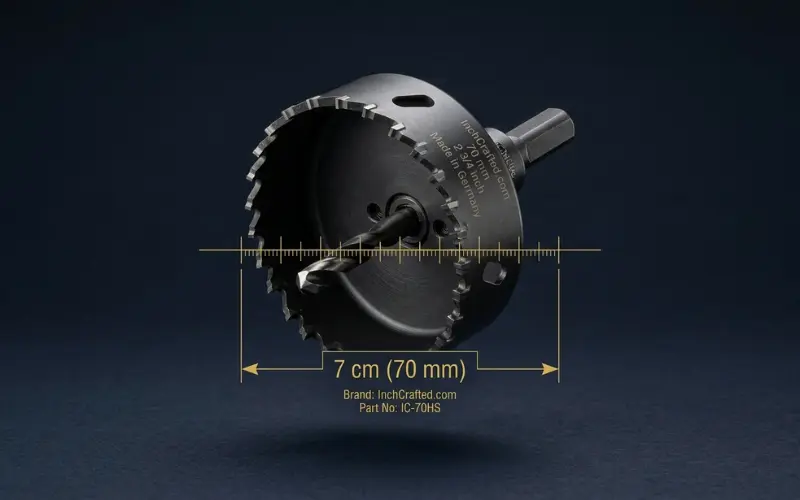
Hole saws are commonly sold according to their cutting diameter. A model specified as 70 mm provides an exact 7 cm reference for the size of the opening it is designed to cut.
This example makes the measurement easier to picture in a practical setting. A 7 cm hole is large enough for some cable, ventilation, or installation applications but remains relatively compact.
The exact dimension should always be checked for the individual product because nearby sizes such as 68 mm or 73 mm are also common.
3. A 70 mm Petri Dish

Petri dishes are manufactured in different standardized diameters. A dish specifically listed as 70 mm measures 7 cm across.
Viewed from above, it provides a clean and simple visual representation of a 7 cm circle.
Laboratory products can be particularly useful measurement references because their dimensions are often specified precisely in millimeters.
4. A 70 mm Round Craft Template

Craft circles, templates, labels, and cutting guides can be manufactured in exact metric sizes.
A template with a 70 mm diameter is exactly 7 cm across. It provides a useful comparison for paper crafts, decorations, stickers, and design projects.
Unlike estimating from a random household item, the measurement can be checked directly from the product specification.
5. A 70 mm Furniture Leg Pad

Some furniture pads and protective feet are available in sizes measured by diameter. A circular pad specified as 70 mm is exactly 7 cm wide across its center.
This provides another practical example of a 7 cm circular measurement.
However, furniture pads come in many sizes, so only a product specifically marked 70 mm should be used as an exact reference.
6. A Tennis Ball

A tennis ball is a close visual comparison, but it is not exactly 7 cm.
Official tennis ball specifications allow a diameter range of approximately 6.54 to 6.86 cm. That places it slightly below 7 cm.
Even though it is not an exact match, a tennis ball can help you imagine the overall scale of a 7 cm measurement because the difference is small.
7. A Large Egg

An egg can provide a rough visual comparison for a measurement around this size, depending on its orientation and the individual egg.
Eggs naturally vary in length, width, and shape, so they should never be treated as an exact 7 cm measurement.
As a general visual reference, however, a large egg can help show that 7 cm is a clearly noticeable small-object measurement rather than a tiny dimension.
8. A 70 mm Round Biscuit Cutter
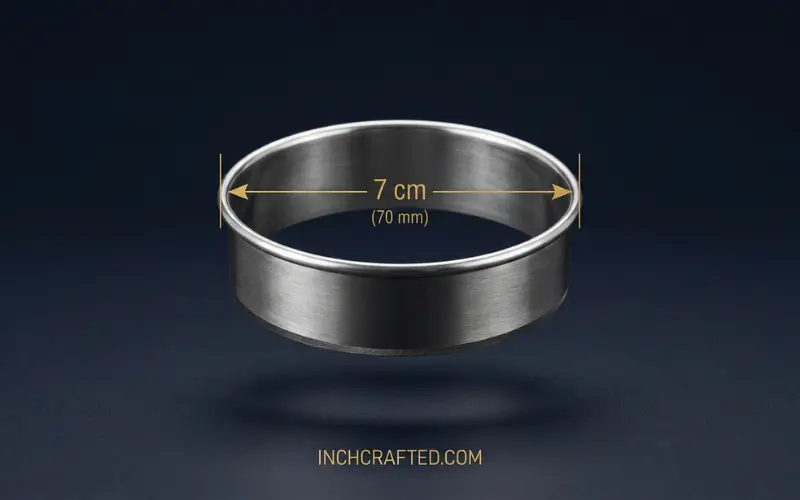
A biscuit or cookie cutter labeled 70 mm gives you another exact 7 cm diameter reference.
This can be particularly easy to visualize because a 7 cm circle is large enough to produce a small biscuit or pastry while remaining compact.
It also demonstrates that 7 cm is wider than many small bottle caps but significantly smaller than the diameter of a typical dinner plate.
9. Just Under 3 Inches on a Ruler
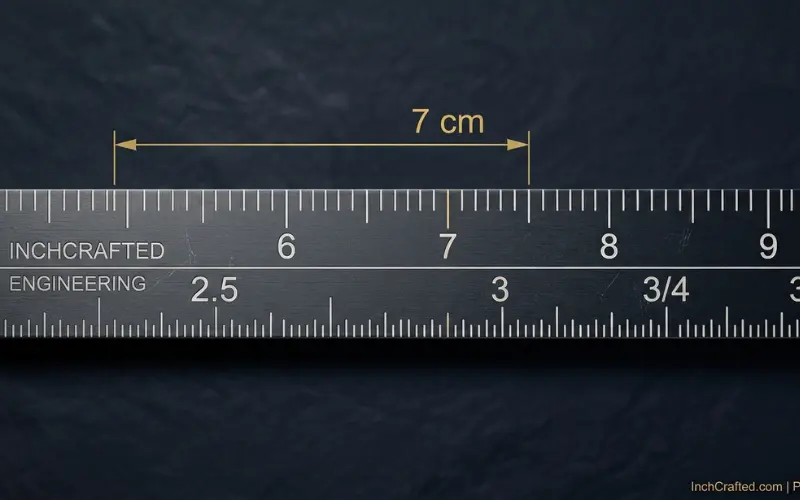
A 7 cm measurement reaches 2.76 inches.
That means the most useful inch-based visual reference is a point slightly above 2¾ inches and just short of 3 inches.
This is one of the best comparisons for readers who regularly use inches instead of centimeters because it shows exactly where the measurement falls.
Where You May See 7 cm in Everyday Life
Seven centimeters may appear in product specifications more often than you realize.
Small accessories, craft supplies, replacement parts, furniture components, and DIY tools frequently use metric measurements. In many cases, the dimension may be listed as 70 mm rather than 7 cm.
This is especially common when manufacturers need to provide precise product specifications.
You may also encounter 7 cm in medical reports, scientific information, or pregnancy-related measurements. In these situations, the measurement describes physical size, but its meaning depends heavily on the context.
That distinction is important. A 7 cm tool diameter, a 7 cm cyst, and a baby measurement of 7 cm are all physically the same length, but they should not be interpreted in the same way.
6 cm vs 7 cm
The difference between 6 cm and 7 cm is only 1 centimeter, but that represents a noticeable increase when dealing with smaller objects.
| Measurement | Inches |
| 6 cm | 2.36 in |
| 7 cm | 2.76 in |
Seven centimeters is approximately 16.7% longer than 6 cm.
If you have already read our guide on How Big Is 6 cm?, you can use it as a helpful comparison for seeing how much difference one additional centimeter can make.
To see the smaller measurement in more detail, check our complete guide on how big is 6 cm.7 cm vs 3 Inches
This comparison is especially useful because many people assume that 7 cm equals 3 inches.
It does not.
7 cm = 2.76 inches
3 inches = 7.62 cm
The difference is:
7.62 cm − 7 cm = 0.62 cm
So a 3-inch object is slightly more than half a centimeter longer than 7 cm.
If you are estimating 7 cm with an inch ruler, stop before the 3-inch mark.
7 cm vs 10 cm
Ten centimeters is significantly larger than 7 cm.
| Measurement | Inches |
| 7 cm | 2.76 in |
| 10 cm | 3.94 in |
The difference is 3 cm, which is substantial when comparing smaller objects.
Ten centimeters is approximately 43% longer than 7 cm.
This comparison can help when reading product descriptions and deciding whether an item will appear compact or noticeably larger.
For a larger size comparison, see exactly how big is 10 cm and how it compares with everyday objects.How Big Is a 7 cm Cyst?
A 7 cm cyst measures approximately 2.76 inches across the dimension being reported.
However, the phrase “7 cm cyst” does not provide enough information to determine whether a cyst is serious, large for its location, or requires a particular treatment. The significance depends on the type of cyst, where it is located, its appearance on imaging, symptoms, and other clinical findings.
A cyst may also have more than one measurement. For example:
7 × 5 × 4 cm
In this case, 7 cm is the largest listed dimension. It does not mean the cyst is 7 cm in every direction.
For visualization purposes, 7 cm is a little under 3 inches. But the medical meaning of that measurement should be discussed with the clinician interpreting the scan or report.
How Big Is a 7 cm Baby?
The phrase “7 cm baby” can be misleading because there is no single pregnancy stage represented by 7 cm.
Baby measurements can be taken in different ways, including:
- Crown-to-rump length
- Head-to-heel length
- Head circumference
- Other ultrasound measurements
Because of this, a 7 cm measurement does not automatically correspond to one exact week of pregnancy without knowing what was measured.
If a pregnancy scan or medical report lists a baby-related measurement of 7 cm, the name of that measurement is important. A 7 cm crown-to-rump length and a 7 cm head-to-heel length describe very different stages and dimensions.
For general visualization only, 7 cm is approximately 2.76 inches long.
Common Mistakes When Estimating 7 cm
Confusing 7 cm With 7 Inches
These measurements are very different.
7 cm = 2.76 inches
7 inches = 17.78 cm
Seven inches is more than two and a half times longer than 7 cm.
Assuming 7 cm Is Exactly 3 Inches
Three inches equals 7.62 cm.
Seven centimeters is approximately 0.24 inches shorter than 3 inches.
Using Approximate Objects as Exact Measurements
A tennis ball, egg, computer mouse, soap bar, or similar object can vary in size.
These objects may help with visualization, but they should not be described as exactly 7 cm unless the specific product or item has a verified 7 cm dimension.
Confusing Diameter With Length
A circular object with a 7 cm diameter measures 7 cm across its center.
Its circumference is much longer than 7 cm.
Always check which dimension a product specification describes.
Measuring From the Edge Instead of the Zero Mark
Some rulers have a small space before the printed zero.
Start measuring from the 0 mark, not necessarily from the physical edge of the ruler.
FAQs
How big is 7 cm in inches?
7 cm equals approximately 2.76 inches.
How big is 7 cm to inches?
Seven centimeters converts to 2.7559 inches, usually rounded to 2.76 inches.
Is 7 cm close to 3 inches?
Yes. Seven centimeters is close to 3 inches but is slightly shorter. 3 inches equals 7.62 cm.
What does 7 cm actual size look like?
A 7 cm line extends from 0 to 7 on a metric ruler. On an inch ruler, it falls just above 2¾ inches.
How many millimeters is 7 cm?
7 cm equals 70 mm.
Is a tennis ball 7 cm?
A tennis ball is close to 7 cm but slightly smaller. Official specifications place its diameter below 7 cm.
How big is a 7 cm cyst?
A 7 cm cyst measures about 2.76 inches across the reported dimension. Its medical significance depends on the type, location, and other findings.
How big is a 7 cm baby?
A 7 cm baby measurement equals approximately 2.76 inches, but the pregnancy stage cannot be determined from that number alone because different measurements are used during pregnancy.
Is 7 cm considered small?
For most everyday objects, 7 cm is considered a relatively small measurement. It is just under 3 inches long but still large enough to be clearly visible and easy to handle.
Conclusion
If you only remember one thing, remember this:
7 cm is almost exactly 2¾ inches and just under 3 inches.
For a precise reference, use a 7 cm line or an item with a verified 70 mm specification. For a quick visual estimate, think of something close to the size of a tennis ball, while remembering that a standard tennis ball is slightly smaller than 7 cm.
This approach gives you a more reliable picture than relying on random household objects, which can vary widely in size. Whether you are checking a product dimension, comparing measurements, reading a medical report, or simply trying to visualize how big 7 cm is, knowing its position between 2¾ and 3 inches makes the measurement much easier to picture.